
Workshop 13
Applied Biostratigraphy – A Critical Tool for Subsurface Prediction and Characterization Monday, June 8th | Room 12
Convenors
- Dr. Mike Simmons (Halliburton/Natural History Museum)
- Dr. Mike Bidgood (GSS Geoscience Ltd.)
- Dr. Matt Wakefield (Lealt Stratigraphic Consultants Ltd.)
- Dr. Emma Sheldon (GEUS)
Description
Biostratigraphy is the use of fossils to characterise rock units in terms of (broadly speaking) relative age and environment of deposition. A combination of knowledge of these two aspects provides a remarkable set of tools and applications that improve our understanding of the subsurface and our ability to predict what may be present in areas of low or poor data control. This includes development of play concepts, play mapping, correlation at regional and at asset scale, and operational (real-time) decision making (i.e., at wellsite). The transformation of biostratigraphical data and its interpretation in the age of AI and machine learning forms part of the course.
Note: This workshop does not teach you how to recognise and identify fossils. It focuses on the applications of biostratigraphical data to the understanding of the subsurface.
The workshop follows a pathway involving a brief explanation of the theory of each component, followed by a practical exercise that demonstrates the principle using mostly “real-world” examples, e.g., from Middle East carbonates and Gulf of Mexico clastics.
For operational demonstrations, delegates will “role-play” the duties of a wellsite biostratigrapher and biosteer a horizontal well in “real time”.
The workshop is based around real-world examples where actual biostratigraphical data is used in various ways to enhance our understanding of the subsurface, in particular the stratigraphic arrangement of rocks and facies in time and space. This understanding, together with the knowledge of how ancient life was distributed and affected by environmental factors, builds into a remarkable predictive tool under the umbrella of sequence (bio)stratigraphy.
The inherent flexibility of biostratigraphical techniques is demonstrated at all scales, from the exploration of major basins down to a detailed understanding of individual assets, and also at an operational level where exploration work requires months of study, down to local drilling situations where stratigraphic decisions are required in a matter of just a few hours.
Biostratigraphical techniques learned during the “hydrocarbons era” are equally applicable (and necessary) to the Energy Transition. Although in its early phase with limited examples, we will demonstrate uses in windfarm development, geothermal, CCUS, and aquifer studies.
Our approach is emphatically not about the fossils themselves. It is about what biostratigraphical data looks like to the non-specialist, and – more importantly – how that data is productively used. We aim to highlight the importance of being “informed users/buyers of applied biostratigraphical services/reports” rather than being able to be an applied biostratigrapher. No previous paleontological or biostratigraphical knowledge is required.
Upon completion of the workshop, participants will know:
- How biostratigraphy “works” from first principles
- How these principles are applied, at various scales, to better understand the subsurface
- How these techniques can be used in a predictive sense through the application of sequence (bio)stratigraphy
- How the techniques are used at an operational level to enhance outcomes economically, technically, and safely
- Upon completion of the workshop, participants will be able to recommend biostratigraphy as appropriate as part of subsurface studies and engage with expert biostratigraphers to ensure successful outcomes.
Sub-Topics that will be covered in the workshop:
- Applied biostratigraphy: correlation and palaeoenvironment (including practical exercise)
- Organising the subsurface: sequence biostratigraphy and prediction (including practical exercise)
- Digital biostratigraphy
- Operational uses: biosteering (including practical exercise)
- The energy transition: where does biostratigraphy go from here?
Participant Profile
Anyone studying or working on the subsurface that requires an understanding of the way the subsurface can be characterised and predicted at a variety of scales; Geoscientists/geoengineers at post-graduate level (M.Sc., Ph.D.) and early/mid-career professionals.
A general background in the broad geosciences is useful but not essential.
No prior knowledge of biostratigraphy (or palaeontology) is required.
Workshop Programme
| Time | Activity |
|---|---|
| 09:00 | Welcome Remarks |
| Session 1: The Big Picture | |
| 09:05 | Keynote Presentation: The Subsurface is in Demand – subsurface characterisation and the role of biostratigraphy - Mike Simmons (Halliburton/NHM) |
| Predicting and characterizing the subsurface remains a key endeavour for applied geoscientists. Biostratigraphy provides critical support through its ability to support correlation within the subsurface and to determine depositional environments of sedimentary rock units. A combination of time-based correlation and paleoenvironmental interpretation under the umbrella of sequence stratigraphy helps organize stratigraphic information and allows for predictions to be made as to the sedimentary successions and their character that can be expected between data-points and in data-poor regions. Issues that can be typically resolved by biostratigraphy occur at a wide variety of scales and – in decreasing order of scale – include generation of play concepts and global- and basin-scale play screening through support of correlation, Earth systems science context (e.g. paleoclimate, eustasy), gross depositional environment mapping, and sequence stratigraphy; age frameworks for basin modelling; appraising assets; and the effective, efficient and safe exploitation of assets through operational biostratigraphy including casing/coring picks and biosteering. Applied biostratigraphy has supported the ongoing efforts of the oil and gas industry for over one hundred years and the lessons from these endeavours can be applied to alternative subsurface use cases, including storage, defining optimal locations for low-carbon energy sources such as geothermal, and for engineering projects associated with, for example, wind-farm location. Importantly, biostratigraphic data is suitable for assisted interpretation arising from the digital revolution, meaning that data gathering and interpretation are becoming faster and better integrated | |
| 09:45 | Prediction – biostratigraphy and sequence stratigraphy. Looking for new plays around the Bab Basin, Arabian Platform (*) - Mike Simmons (Halliburton/NHM) & Mike Bidgood (GSS Geoscience) |
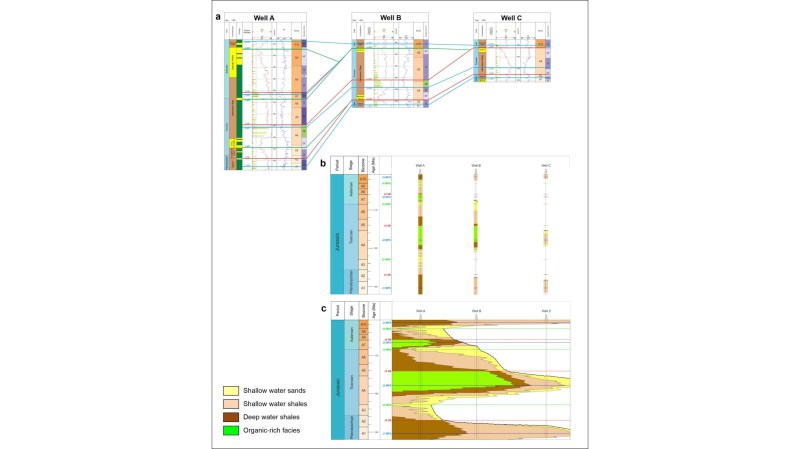
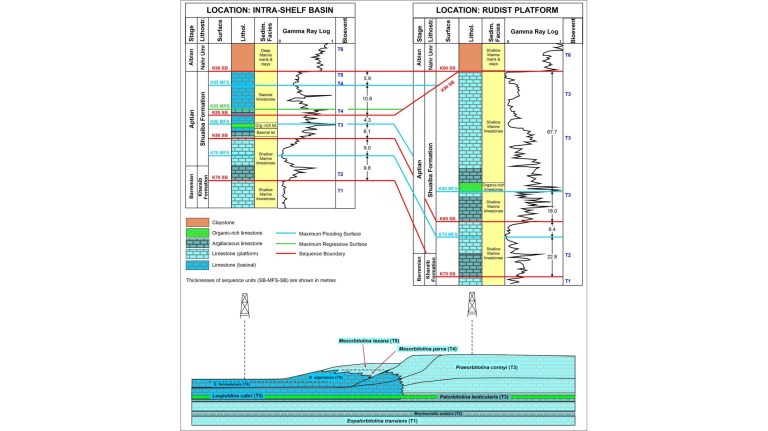
| The Aptian (Early Cretaceous) Shuaiba Formation and its equivalents represent a key reservoir and source rock interval in the eastern part of the Arabian Plate with important large oil fields relating to this rock unit known in Oman, Abu Dhabi, Saudi Arabia, Qatar and Iran. More recently it has been reviewed as a potential rock unit for CO2 storage, either in depleted oil fields or as a saline aquifer. We briefly summarize the manner in which biostratigraphy has contributed to the development of subsurface models of the formation and highlighted play concepts that have gone on to be successfully explored. Focusing on the area centred around the borders between Abu Dhabi, Oman, and Saudi Arabia, it has long been known that the Shuaiba Formation could be differentiated into three key depositional settings: (i) a sub-circular intrashelf basin (the Bab Basin) rimmed by (ii) rudist-bivalve dominated bioherms, landward of which lay (iii) a broad shallow marine carbonate platform, with lagoonal facies. Unsurprisingly, wells within the intrashelf basin have a rather different log character to those within the bioherms or the carbonate platform, making simple log correlation difficult. Recognition of biozones enables temporally realistic correlations to be carried out between wells. These correlations showed that whilst carbonate platform sedimentation was initially uniform across the entire region at the beginning of Shuaiba deposition, it differentiated into a rapidly aggrading carbonate platform margin and a condensed intrashelf basin. Subsequently sea-level fell causing cessation of carbonate platform deposition and improvement of reservoir quality through meteoric diagenesis. Meanwhile, in the basin deposition continued with progradation occurring. The biostratigraphy constrained correlation and sequence stratigraphic interpretation not only helped explain the excellent reservoir quality in the known Shuaiba platform but highlighted the potential for the shelf margin to have shifted basinward during the sea-level fall highlighting a potential new play concept. | |
| 10:15 | Coffee break |
| 10:30 | Prediction/Bab Basin (*) ctd… |
| 11:15 | Group discussion |
| 11:45 | Lunch |
| Session 2: Assets and Operations | |
| 12:45 | Keynote Presentation: Leave No Dollar Behind – defining your asset and making the most of it - Matt Wakefield (Lealt Stratigraphic) |
| There are key themes to consider; firstly reservoir characterisation before, during and post development drilling including within reservoir models, and secondly the focussed use of well-site biostratigraphy, which may also be used to aid the delivery of both exploration and appraisal wells. Interdisciplinary communication is key to delivery both within the operators’ geoscience staff and also with biostratigraphical contractors and logistics and drilling staff, ensuring studies and deliverables are understood by all. Reservoir characterisation is not simply the development of field specific high-resolution biostratigraphy but also palaeoenvironmental analysis to help improve sedimentary facies modelling; deliverables from both areas impact static and dynamic reservoir models. A basic workflow will be used to aid discussion along with worked examples. Reservoir characterisation, coupled with well design to meet production needs may necessitate the use of well-site biostratigraphy. | |
| 13:15 | Target horizon identification. Picking casing points in the Gorm Field, North Sea - Emma Sheldon (GEUS) |
| 13:30 | Biosteering – turn your asset into a goldmine. Valhall & Joanne Fields, North Sea (*) - Mike Bidgood (GSS) & Matt Wakefield (Lealt) |
| The Valhall Field (Norwegian North Sea, initially Amoco, now Aker BP, discovered 1975) was estimated to have initial reserves of 257 million barrels. A large number of horizonal producer and injector wells, “biosteered” using continuous 24-hour wellsite biostratigraphy since the 1980s, has resulted in increased production rates and enabled the subsurface reservoir to be mapped in detail by the increase of stratigraphic knowledge and confidence. North and South Flank (i.e., extension) areas of the reservoir were drilled beginning in the 2000s, again, using biosteering. Field life has been extended out to 2050 and a re-estimate of reserves is currently approximately 1.2 billion barrels. | |
| 14:00 | Coffee Break |
| 14:15 | Group discussion |
| Session 3: Biostratigraphy and the Energy Transition | |
| 14:30 | Keynote Presentation: Biostratigraphy’s Role in a Low-Carbon Energy World - Emma Sheldon (GEUS) |
| The ongoing energy transition means that subsurface characterization is still very much in demand and will continue to be so for the foreseeable future. Studies describing and predicting the disposition and properties of subsurface rock units will continue to include applied biostratigraphy due to its significant importance in supporting correlation within the subsurface and to determine depositional environments of sedimentary rock units. Applied biostratigraphy has supported the oil and gas industry for over a century and the knowledge gained can be applied to alternative subsurface uses, including defining optimal locations for CO2 storage and low carbon energy sources such as geothermal, and for engineering projects associated with wind-farm location. As much as before, biostratigraphy will play an important role in meeting the energy demands of society, requiring the ongoing education of practitioners as well as informed users of this expertise. | |
| 15:00 | Group discussion and wrap-up |
| 15:30 | End of Workshop |
| (*) involves delegate-participation in practical demonstrations |